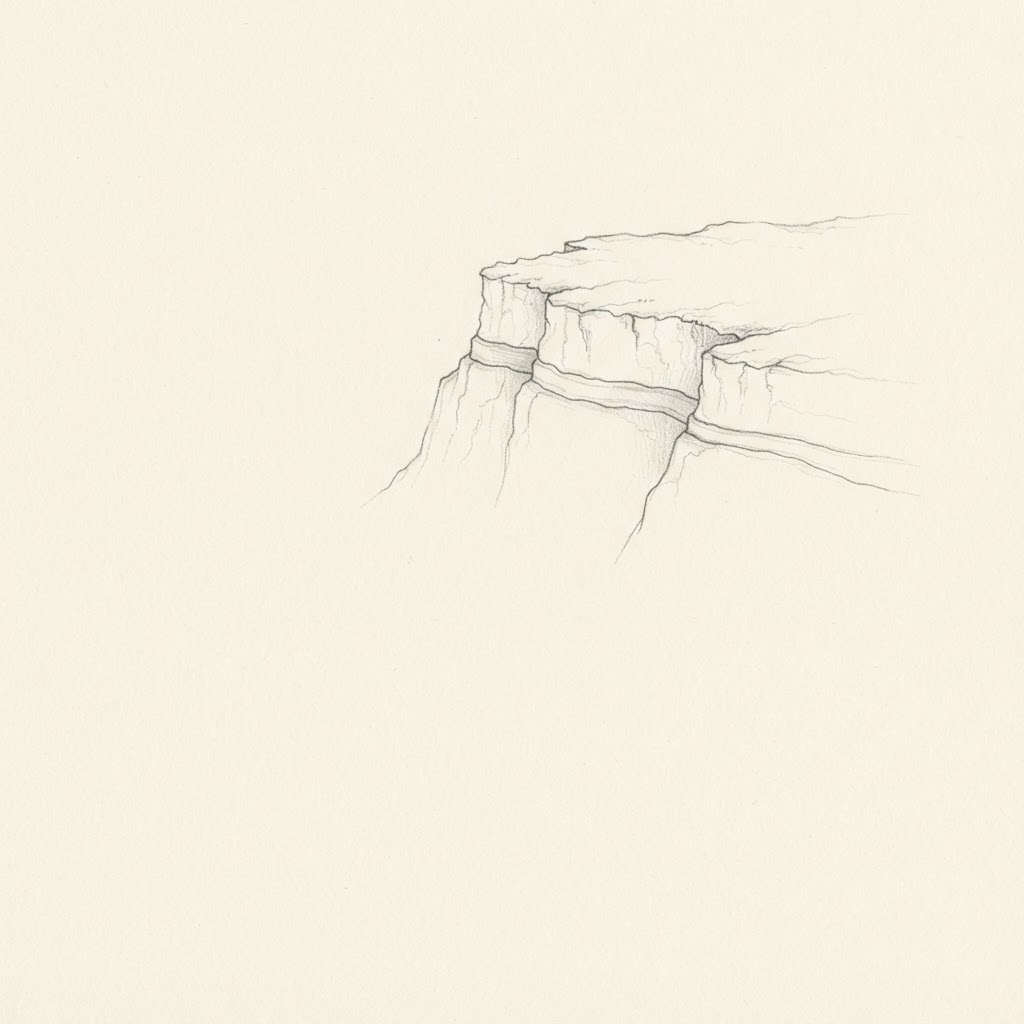
Canyon
Lectio Ruptae
Reading the Canyon
The Canyon Reforms
Canyon · Reforms
A canyon is formed by removal.
Water cuts.
Rock yields.
Layer after layer is exposed.
What appears permanent is slowly reshaped by forces that seem almost insignificant in a single moment.
Canyons teach us that transformation is rarely instantaneous.
It happens through pressure, time, surrender, and depth.
Throughout Scripture, God repeatedly meets people in valleys, ravines, pits, and low places.
Not simply to get them out—
but to form them while they are there.
Wilderness
A canyon is a record of what has been endured.
Look at its walls and you are looking backward through time.
Sediment accumulated.
Stone hardened.
Earth lifted.
Then water began its patient work.
A river does not overpower a canyon all at once.
It persists.
Grain by grain.
Season by season.
Flood by flood.
What looks immovable slowly gives way.
And as the canyon deepens, hidden layers become visible.
Rock that once existed far beneath the surface is exposed to light.
That is part of what makes canyons so disorienting.
The world above disappears.
Horizons narrow.
Walls rise.
Sound changes.
Light arrives differently.
You descend into a place where your perspective is shaped by what surrounds you.
And yet the deepest places often reveal the longest story.
Canyon walls preserve evidence of upheaval, erosion, drought, flood, pressure, and time.
What has been cut away becomes revelation.
Depth is not evidence that nothing has happened.
Sometimes depth is evidence that formation has been happening for a very long time.
Word
Scripture repeatedly takes people into low places when something in them—or around them—is being reformed.
The Bible's language is more often valley, pit, ravine, or wilderness than canyon.
But the spiritual geography is familiar.
You descend.
The horizon narrows.
Control disappears.
And God meets people in the depths.
Genesis 37:23–28 · Joseph
Joseph's brothers strip him of his robe and throw him into a pit.
The favored son becomes the forgotten brother.
The dreams remain.
But everything Joseph believed those dreams might mean is dismantled.
He will descend again—
into slavery,
into accusation,
into prison.
Joseph's formation does not happen by moving steadily upward.
It happens through repeated descent.
Years later, the man who emerges is capable of carrying power differently than the boy who first dreamed of it.
The pit does not tell the whole story.
But the pit becomes part of the formation.
1 Kings 17:2–6 · Elijah
During drought, God sends Elijah away from public confrontation and into hiding:
“Hide yourself by the Wadi Cherith.”
A wadi is a ravine or channel carved by water.
Elijah descends out of visibility.
There is no audience.
No victory on Carmel.
No dramatic confrontation.
Only a stream.
Ravens.
Daily provision.
Before Elijah stands publicly before Israel, God forms him privately in a ravine.
Sometimes God reforms us by removing the audience.
Psalm 23:4 · David
David writes:
“Even though I walk through the darkest valley, I fear no evil; for you are with me.”
Something changes in the psalm here.
Before the valley, David speaks about God:
“He makes me lie down.”
“He leads me.”
“He restores my soul.”
But in the valley, the pronoun shifts.
“For you are with me.”
The low place turns theology into encounter.
The Shepherd is no longer merely someone David describes.
He becomes someone David addresses.
The valley narrows the distance.
What David knew about God becomes communion with God.
Psalm 84:5–7 · The Valley of Baca
The psalmist describes pilgrims traveling toward God:
“As they go through the valley of Baca they make it a place of springs.”
The valley is not avoided.
It is crossed.
And somehow the place of weeping becomes a place where water gathers.
The pilgrims do not wait for perfect conditions before continuing toward God.
They pass through difficulty and discover that even sorrow can become a place of provision.
The valley remains a valley.
But it does not remain barren.
Ezekiel 37:1–14 · Ezekiel
The Spirit brings Ezekiel into:
“the middle of a valley”
filled with bones.
Not merely dead.
Dry.
Beyond recovery.
God asks:
“Mortal, can these bones live?”
Ezekiel does not pretend to know.
“O Lord GOD, you know.”
Then God tells him to speak.
Bones join.
Breath enters.
Life returns.
The valley that appeared to contain only evidence of death becomes the place where resurrection is imagined.
God does not ask Ezekiel to deny what he sees.
He teaches him that what he sees is not the limit of what God can do.
John 18:1 · Jesus
On the night of his arrest, Jesus crosses the Kidron Valley with his disciples.
On the other side is a garden.
Gethsemane.
Prayer.
Anguish.
Surrender.
Jesus enters the deepest narrowing of his earthly life.
The options close.
The cross approaches.
And his prayer becomes:
“Not my will but yours be done.”
Jesus does not escape the descent.
He entrusts himself to the Father within it.
Christian faith does not proclaim a God who watches suffering safely from above.
It proclaims a God who descends into it.
Philippians 2:5–11 · Resurrection
Paul describes the movement of Christ as descent.
Christ:
“emptied himself”
and:
“humbled himself and became obedient to the point of death—even death on a cross.”
Then the movement changes.
“Therefore God also highly exalted him.”
Down.
Then up.
Descent.
Then resurrection.
The Christian story does not teach us to seek suffering for its own sake.
But it does teach us that descent is not necessarily defeat.
God can form new life in the lowest places.
The Pattern
Across Scripture, the low place repeatedly becomes a place of formation.
Joseph descends into the pit and emerges able to carry power differently.
Elijah disappears into the ravine and learns daily dependence.
David enters the valley and begins speaking directly to God.
Pilgrims cross the Valley of Baca and discover springs.
Ezekiel stands among dry bones and encounters the possibility of resurrection.
Jesus crosses the Kidron and surrenders himself to the Father.
Christ descends even into death—and death does not get the final word.
Again and again, Scripture refuses to equate down with lost.
The valley may narrow your horizon.
The walls may close in.
What you once depended upon may be cut away.
But the depths can expose what the surface concealed.
That is what a canyon does.
Layer after layer becomes visible through removal.
And that is often how formation works.
Not everything God removes is punishment.
Not every limitation is abandonment.
Not every descent means you are moving away from God.
Sometimes the place where your world becomes smaller is the place where God's presence becomes more immediate.
Sometimes what is being cut away is making something deeper visible.
The Canyon Reforms.
The Canyon Reforms
We usually imagine transformation as addition.
More knowledge.
More strength.
More opportunity.
More certainty.
More control.
The canyon offers another image.
Formation through subtraction.
Rock is removed.
The channel deepens.
Hidden layers appear.
A new landscape emerges.
There are seasons when God seems to work this way in us.
Certainties erode.
Control weakens.
Identities we depended upon are exposed.
Outcomes we thought we could guarantee move beyond our reach.
The horizon narrows.
And we wonder whether something has gone wrong.
But Scripture repeatedly tells another story.
Joseph is still being formed in the pit.
Elijah is still being formed in the ravine.
David is still being shepherded in the valley.
Ezekiel is still standing within the reach of resurrection.
Jesus is still beloved while crossing the Kidron.
The low place is not outside the presence of God.
And perhaps that is why David's language becomes more intimate there.
Before the valley:
He.
Inside the valley:
You.
“For you are with me.”
The canyon reforms us when what we knew about God becomes something we learn to entrust ourselves to.
Not because the walls disappear.
But because we discover that God is with us between them.
Enter the Canyon
You have read the canyon.
Now enter it.
If you are physically in one, begin by descending slowly.
Notice what happens to the horizon.
Look at the walls.
Notice the layers.
The fractures.
The places where water has passed.
Listen to how sound changes.
Notice where light reaches and where shadow remains.
Do not begin by interpreting.
Begin by noticing.
What has been cut away?
What has been exposed?
What evidence of pressure, time, or persistence can you see?
Then allow the landscape to become prayer.
Where has life narrowed for you?
What are you no longer able to control?
What has been exposed in you that was easier to hide on the surface?
Is there anything you have interpreted as abandonment that might instead become a place of deeper encounter?
And perhaps most importantly:
Can you shift, even for a moment, from speaking about God to speaking to God?
You are with me.
Here.
Between these walls.
In this depth.
In what I cannot yet understand.
Stay there.
You do not need to climb out immediately.
The canyon has taken a long time to become what it is.
Formation may take time too.
What is being removed may yet reveal something deeper.
The Canyon Reforms
Continue into ATTEND and allow the Canyon to become more than something you understand. Let it become somewhere you meet God.